


How Are Peptide Synthesis Techniques Performed in Labs?
Most research peptides are built in the lab by solid-phase peptide synthesis (SPPS) — assembling the chain one amino acid at a time on a solid resin, using protecting-group chemistry to control each step. This guide explains the fundamentals: solid-phase vs liquid-phase peptide synthesis methods, the Fmoc and Boc strategies, the step-by-step SPPS cycle, the coupling reagents that drive each bond, and how chemists protect purity by preventing racemization.
Editorial & research disclaimer: This article is for educational purposes only. It explains the chemistry of how peptides are synthesized in laboratories and is not medical advice or product guidance.

Quick Answer
How are peptides synthesized in labs? The dominant method is solid-phase peptide synthesis (SPPS), pioneered by Bruce Merrifield. The growing peptide is anchored to insoluble resin beads and built one amino acid at a time through repeating cycles of deprotection and coupling, with excess reagents simply washed away between steps. Liquid-phase synthesis is still used for short or large-scale peptides, while techniques like native chemical ligation allow for the assembly of even larger proteins.
Two protecting-group strategies dominate: Fmoc (base-labile, the modern standard) and Boc (acid-labile). After assembly, the peptide is cleaved from the resin, deprotected, and purified — usually by high-performance liquid chromatography (HPLC) — then verified by mass spectrometry.
SPPS is the workhorse: the chain is built on solid resin, one amino acid at a time, with wash-away purification between steps.
Two strategies: Fmoc (base-removable, modern standard) and Boc (acid-removable, older, needs harsh HF cleavage).
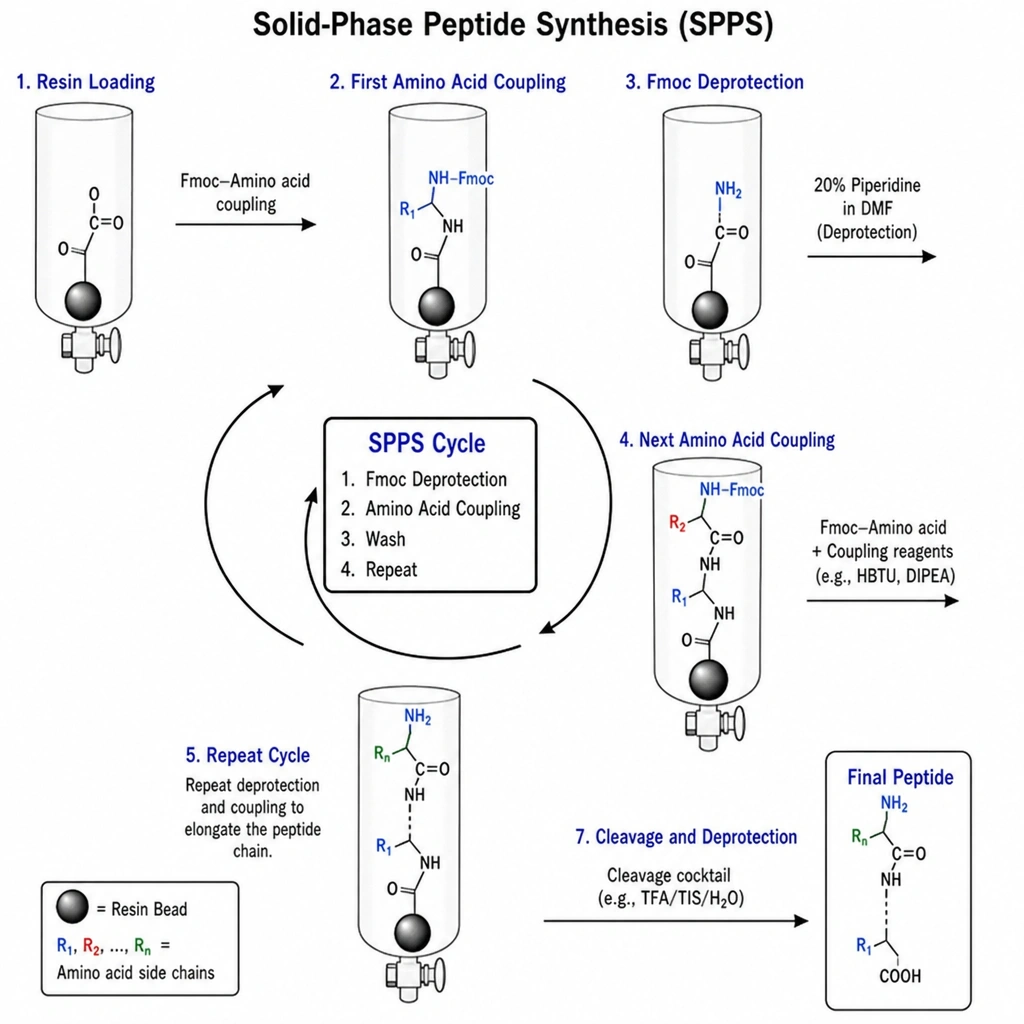
The cycle repeats: deprotect → wash → couple next amino acid → wash, until the sequence is complete.
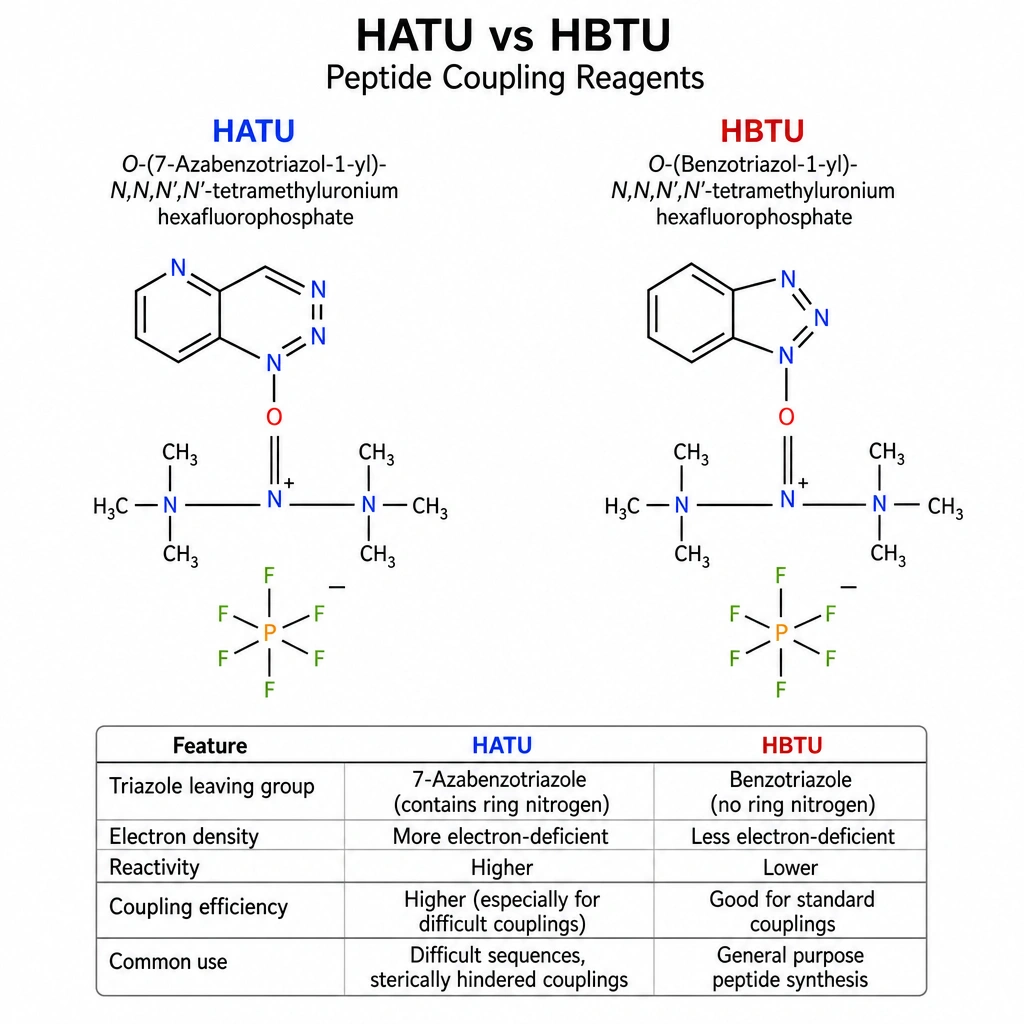
Coupling reagents (carbodiimides like DIC; uronium salts like HBTU/HATU) activate the carboxyl group to form each bond.
Purity is protected by preventing racemization and finished by HPLC purification plus mass-spec verification.
The Fundamentals of Chemical Peptide Synthesis
Chemically synthesizing a peptide through organic synthesis means forming peptide bonds in a controlled, intentional order, allowing for the inclusion of unnatural amino acids. The central challenge is selectivity: each amino acid has reactive functional groups that could bond in the wrong place, so chemists use protecting groups to mask everything except the two groups meant to react at each step. Assembly proceeds from the C-terminus toward the N-terminus — the reverse of how ribosomes build proteins and natural peptides in cells.
The field changed forever when Robert Bruce Merrifield introduced solid-phase synthesis in the 1960s (work that earned a Nobel Prize), anchoring the peptide to a solid support (solid resin support) so excess reagents could be rinsed away instead of painstakingly separated.
Solid-Phase vs Liquid-Phase Peptide Synthesis
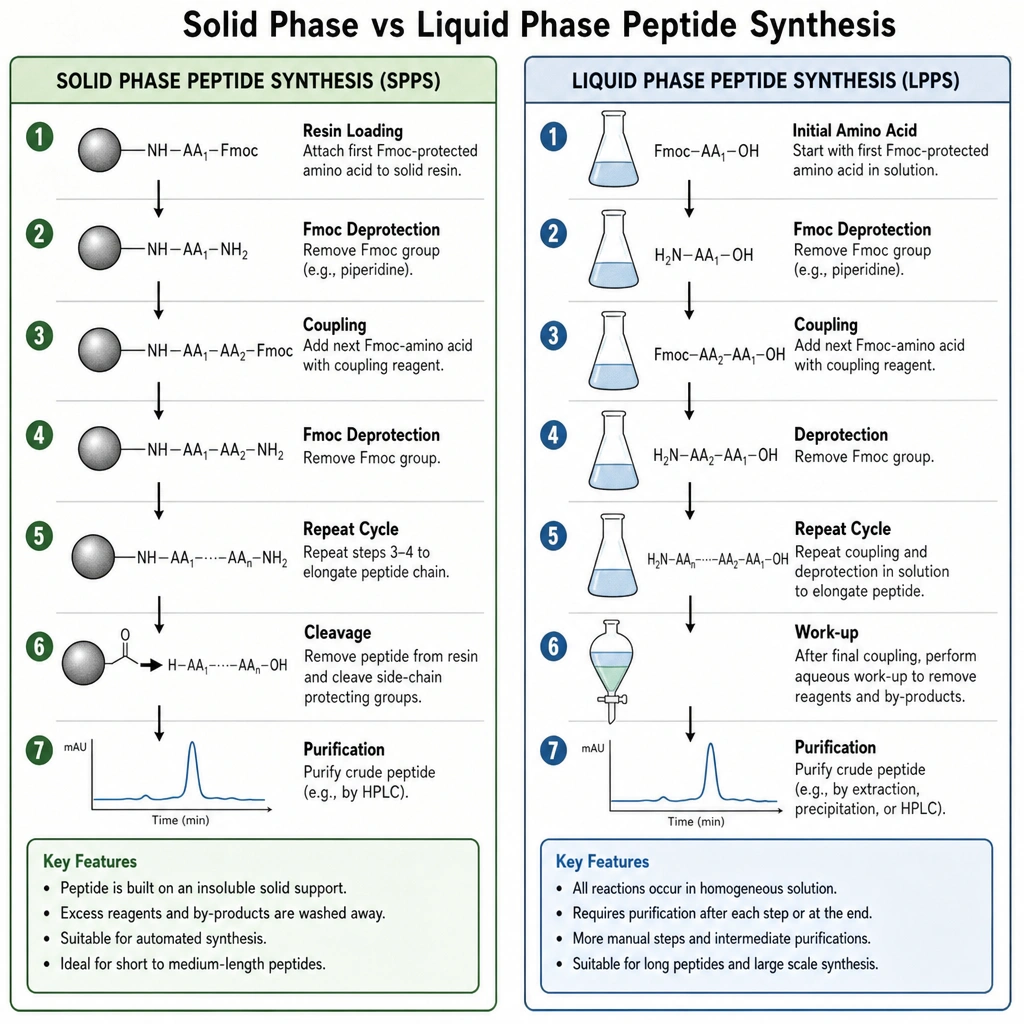
Liquid-phase peptide synthesis (LPPS) carries out reactions in solution and requires purification after most steps. It is labor-intensive for long sequences but remains valuable for very short peptides and certain large-scale manufacturing.
Solid-phase peptide synthesis (SPPS) anchors the first amino acid to insoluble resin beads, such as the widely used Wang resin typically made of cross-linked polystyrene. Because the growing chain stays bound to the resin, reagents and by-products are removed by simple filtration and washing between steps, allowing large reagent excesses to drive reactions to completion. This is why SPPS dominates modern research peptide production and custom peptide synthesis.
- Speed: wash-and-repeat cycles are far faster than isolating intermediates.
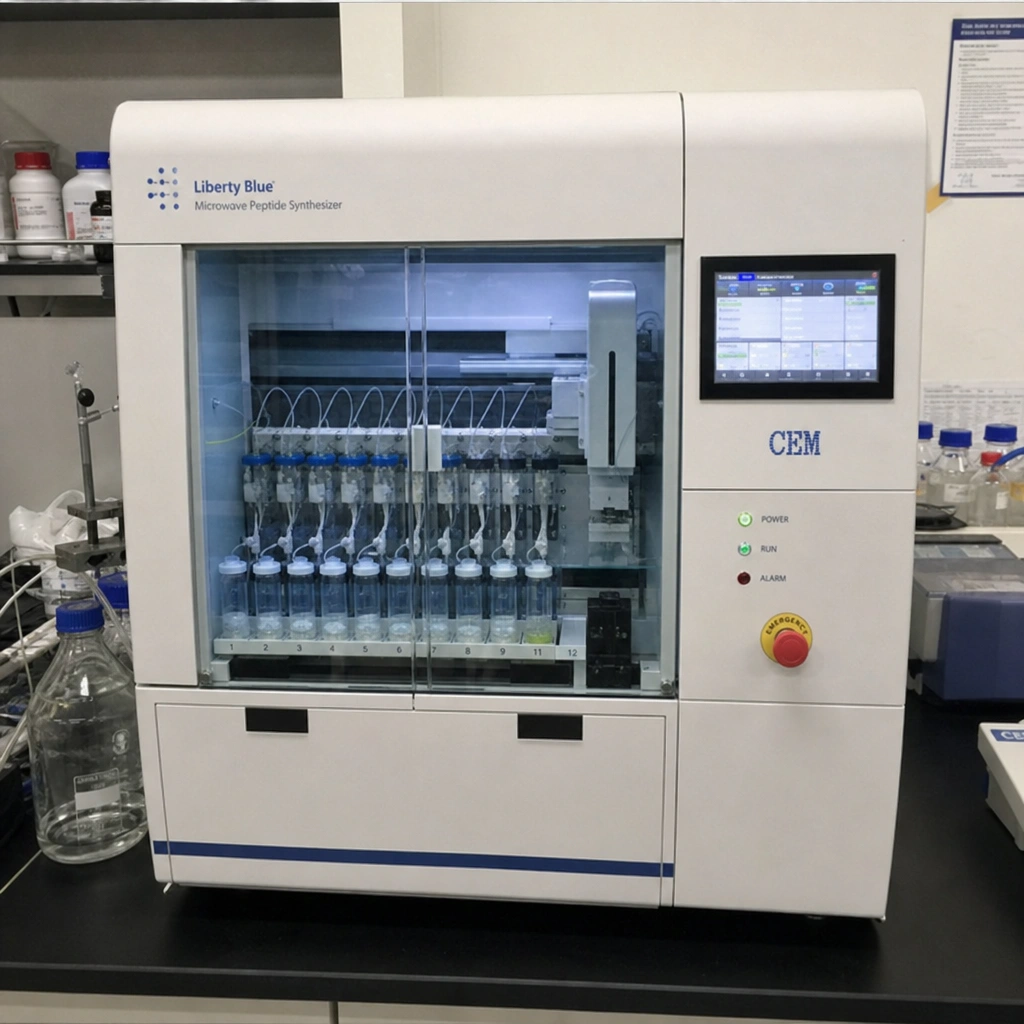
- Automation: SPPS is readily automated by peptide synthesizers.
- Yield: large reagent excess pushes each coupling toward completion.
- Scalability: well suited to research quantities, cyclic peptides, and many therapeutic peptides.
Protecting Group Strategies: Fmoc vs Boc
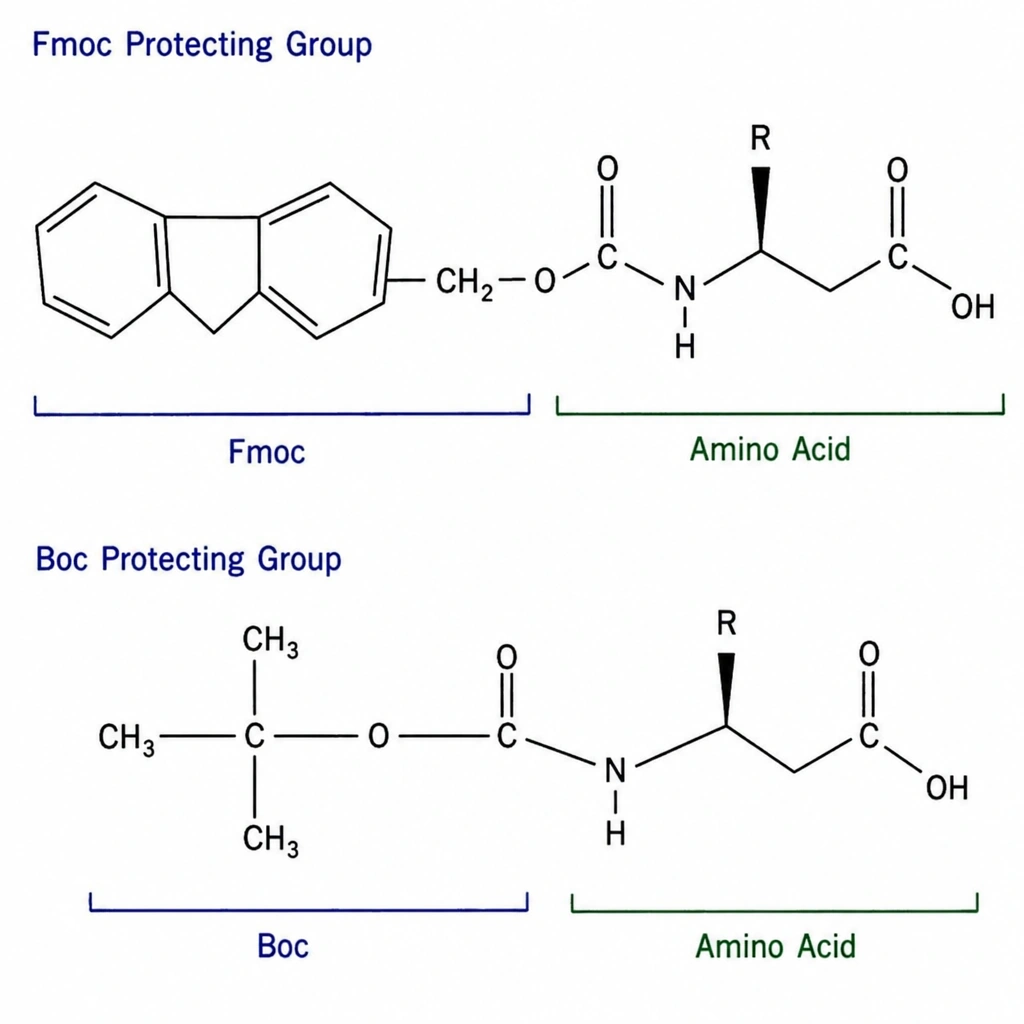
Two protecting-group strategies define modern SPPS, named for the group—such as fluorenylmethyloxycarbonyl (Fmoc)—that shields the amino acid's N-terminus during each coupling.
| Factor | Fmoc | Boc |
|---|---|---|
| Removed by | Mild base (piperidine) | Acid (TFA), final cleavage with HF |
| Conditions | Milder, safer | Harsher, hazardous HF step |
| Modern use | Standard for most research peptides | Specialized / difficult sequences |
| Side-chain protection | Acid-labile (orthogonal) | Benzyl-type |
| Best for | General-purpose synthesis | Certain aggregation-prone peptides |
Fmoc is the default for most laboratories, including those synthesizing cyclic peptides, because its base-mediated deprotection avoids repeated exposure to trifluoroacetic acid and the dangerous hydrogen fluoride cleavage that classic Boc chemistry requires.
The SPPS Cycle: Step-by-Step Chain Elongation
A standard Fmoc SPPS cycle repeats the same four operations for every amino acid added:
- Deprotection: remove the Fmoc group from the resin-bound amino acid's N-terminus with a base (piperidine) in a solvent like DMF, exposing a free amino group.
- Wash: rinse away the deprotection reagents and by-products.
- Coupling: add the next Fmoc-protected amino acid, pre-activated by a coupling reagent, so its carboxyl bonds to the free amino group.
- Wash: rinse away excess reagents, then repeat the cycle for the next residue.
Once the full sequence is assembled, a final cleavage step using scavengers releases the peptide from the resin and removes side-chain protecting groups, yielding the crude peptide ready for purification.
The Chemistry of Activation: Coupling Reagents
A carboxyl group will not spontaneously form a peptide bond fast enough to ensure efficient peptide bond formation and create stable amide bonds, so it must be activated. Coupling reagents make the carboxyl far more reactive toward the incoming amino group.
- Carbodiimides (DIC, DCC): classic activators, often used with additives like HOBt to suppress side reactions.
- Aminium/uronium salts (HBTU, TBTU, HATU): fast, efficient activators widely used in automated SPPS; HATU is prized for difficult couplings.
- Additives (HOBt, Oxyma): reduce racemization and improve coupling efficiency.
Maintaining Purity: Preventing Racemization & Final Cleanup
A major quality threat in synthesis is racemization — the unwanted conversion of an amino acid's chirality (L to D), which produces a subtly wrong molecule. Chemists limit it by using mild bases, efficient coupling reagents with racemization-suppressing additives, lower temperatures, and careful handling of sensitive residues.
After cleavage, the crude peptide is purified — most commonly by reverse-phase HPLC (high-performance liquid chromatography) using a hydrophobic stationary phase — to separate the target from truncated or modified by-products, then verified by mass spectrometry to confirm the correct molecular weight and identity. This HPLC-plus-MS pairing is exactly what a quality Certificate of Analysis reports, which is why understanding synthesis helps you read a COA intelligently. See PrymaLab's Research Hub for more.
Curious how your peptides are actually made?
Understanding SPPS makes a Certificate of Analysis far easier to read. Explore PrymaLab's education and research-grade catalog.
Explore PrymaLab Research PeptidesFrequently Asked Questions
How are peptides synthesized in a lab?
The dominant method is solid-phase peptide synthesis (SPPS): the peptide is anchored to insoluble resin beads and built one amino acid at a time through repeating cycles of deprotection and coupling, with reagents washed away between steps. After assembly the peptide is cleaved from the resin, deprotected, purified by HPLC, and verified by mass spectrometry.
What is the difference between solid-phase and liquid-phase synthesis?
In solid-phase synthesis (SPPS) the growing chain is bound to resin, so by-products are simply filtered and washed away between steps, enabling speed and automation. Liquid-phase synthesis runs reactions in solution and requires purification after most steps; it is still used for very short peptides and some large-scale manufacturing.
What is the difference between Fmoc and Boc?
Fmoc and Boc are protecting-group strategies. Fmoc is removed with a mild base (piperidine) and is the modern standard because it avoids harsh acids. Boc is removed with acid and requires a hazardous hydrogen fluoride step for final cleavage, so it is now reserved for specialized or difficult sequences.
What does a coupling reagent do?
A coupling reagent activates the carboxyl group of the incoming amino acid so it reacts quickly with the free amino group on the chain, forming the peptide bond. Common reagents include carbodiimides (DIC, DCC) and uronium salts (HBTU, HATU), often with additives like HOBt or Oxyma to reduce side reactions.
What is racemization and why does it matter?
Racemization is the unwanted conversion of an amino acid from its natural L-form to the D-form during synthesis, producing a subtly incorrect molecule that can change activity. Chemists minimize it with mild bases, efficient coupling reagents, racemization-suppressing additives, and careful temperature control to preserve purity.
How is a finished peptide purified and verified?
The crude peptide is typically purified by reverse-phase HPLC, which separates the target sequence from truncated or modified by-products. Identity and molecular weight are then confirmed by mass spectrometry. Together, HPLC purity and MS identity are the core data reported on a quality Certificate of Analysis.
Why is SPPS preferred over liquid-phase synthesis?
SPPS is faster, easily automated, and high-yielding because the chain stays on resin and excess reagents are washed away rather than separated by hand. This lets chemists drive each coupling to completion and assemble long sequences efficiently, which is why SPPS dominates modern research peptide production.
Does understanding synthesis help when buying peptides?
Yes. Knowing that quality peptides are purified by HPLC and verified by mass spectrometry helps you read a Certificate of Analysis critically — checking for high HPLC purity, identity confirmation, and an independent third-party lab — instead of trusting vague marketing claims about quality.
References & Further Reading
- Merrifield, R.B. (1963). Solid Phase Peptide Synthesis. I. The Synthesis of a Tetrapeptide. Journal of the American Chemical Society, 85(14), 2149–2154.
- Behrendt, R., White, P., & Offer, J. (2016). Advances in Fmoc solid-phase peptide synthesis. Journal of Peptide Science, 22(1), 4–27.
- Made, V., Els-Heindl, S., & Beck-Sickinger, A.G. (2014). Automated SPPS. Beilstein Journal of Organic Chemistry, 10, 1197–1212.
- Isidro-Llobet, A., Alvarez, M., & Albericio, F. (2009). Amino acid-protecting groups. Chemical Reviews, 109(6), 2455–2504.
PrymaLab resources: Research Hub · Research peptides · Peptide calculator · FAQ · About PrymaLab.
Final disclaimer: This article is an educational explainer about laboratory peptide synthesis. It is not medical advice or product guidance, and nothing here is a recommendation to purchase, possess, or use any compound.
For any health decision, consult a licensed healthcare professional, and verify the legal status of any compound in your jurisdiction.